
Peptides — The Next Frontier in Cellular Medicine
What Are Peptides, and Why Are They Different?
The human body is constantly communicating with itself at the cellular level. That communication depends on signaling molecules — from large steroid hormones to small neurotransmitters — each carrying specific instructions to specific cells. Peptides occupy a unique and powerful position in this signaling universe.
A peptide is simply a chain of amino acids linked together — shorter than a full protein, typically fewer than 40 amino acids, but longer than a single amino acid neurotransmitter. What makes them remarkable is their specificity: each peptide carries a highly targeted biological message, binding to cell-surface receptors and initiating precise intracellular signaling cascades.
Compare this to steroid hormones, which are lipid-soluble and cross cell membranes directly to alter gene transcription in the nucleus — producing broad, systemic effects often governed by feedback loops that take hours, days, or weeks to regulate. Peptide hormones, by contrast, are water-soluble and act through G-protein coupled receptors (GPCRs) and second messengers like cAMP or calcium ions, producing faster and more localized responses. Think of steroid hormones as broadcasting a signal across an entire city — peptides are more like a targeted text message to a specific address.
This precision is what makes therapeutic peptides so attractive in modern medicine. They can be designed or selected to amplify the body’s own repair signals, mimic natural growth factors, modulate inflammation, or enhance neurological resilience — without broadly disrupting the endocrine system.
The Classes of Therapeutic Peptides
The peptide landscape is vast, but for clinical practice, four major functional classes have emerged:
1. Repair & Recovery Peptides
BPC-157, TB-500 (Thymosin Beta-4), GHK-Cu (Copper Tripeptide-1), and KPV — these peptides target tissue regeneration, wound healing, angiogenesis, and inflammation resolution. They are the focus of this first edition.
2. Growth Hormone Secretagogues (GHS)
Sermorelin, ipamorelin, CJC-1295, and tesamorelin stimulate the pituitary gland to release the body’s own growth hormone in a physiological pattern. Unlike exogenous HGH, these work with the hypothalamic-pituitary axis rather than bypassing it. Tesamorelin is the only peptide in this class with full FDA approval — specifically for HIV-associated lipodystrophy — but all four are used clinically for body composition, muscle preservation, metabolic optimization, and longevity protocols.
3. Metabolic Modulators
AOD-9604 (a modified fragment of HGH amino acids 176–191) targets adipose lipolysis via beta-3 adrenergic receptor activation without affecting insulin or IGF-1. MOTS-c, a mitochondrial-derived peptide, activates AMPK — the cellular energy master switch — improving glucose utilization and fatty acid oxidation at the mitochondrial level.
4. Neurocognitive Peptides
Cerebrolysin — a standardized mixture of neuropeptides and free amino acids derived from porcine brain proteins — can cross the blood-brain barrier (due to its small molecular weight) and directly stimulates BDNF, NGF, GDNF, and CNTF, supporting neuronal survival, neurogenesis, and protection from excitotoxic injury cascades. Dihexa and Semax round out this class with emerging evidence in memory, focus, and neuroregeneration.
The Grey Market Problem: Why Sourcing Is Non-Negotiable
Because peptides fall outside the FDA’s standard drug approval framework, the marketplace for them is largely unregulated. In 2023, the FDA categorized 17 popular peptides as “Category 2” bulk drug substances — essentially barring most compounding pharmacies from producing them — citing concerns about impurities and insufficient clinical safety data. That regulatory action sparked legal battles and partial reversals, and as of early 2026, several of these peptides are under active re-review by the Pharmacy Compounding Advisory Committee.
This regulatory uncertainty has created a murky grey market. Online vendors routinely sell peptides labeled “for research use only” — products with unknown purity, incorrect concentrations, microbial contamination risks, and no verified sterility. A 2026 ProPublica investigation noted that even major industry advocacy groups acknowledge they have limited knowledge of the safety profile of individual peptides being sold to the public.
The practical consequence for patients is significant. A contaminated or mislabeled peptide doesn’t just fail to work — it can cause injection site reactions, immune responses, or worse.
At Paradigm Health, we do not take shortcuts here. We source our peptides from a trusted supplier whose products are manufactured 100% in the United States, under rigorous quality control that ensures accurate labeling, pharmaceutical-grade purity, and sterility testing. This is not a minor detail — it is the foundation upon which safe, effective peptide therapy is built.
This Week’s Focus: Repair & Recovery Peptides
BPC-157: The Gastric Protector That Heals Far Beyond the Stomach
BPC-157 — Body Protection Compound-157 — is a stable pentadecapeptide (15 amino acids) naturally present in gastric juice, where it plays a role in maintaining mucosal integrity. Decades of research have revealed that its repair capabilities extend far beyond the gut.
Mechanisms of action:
· Angiogenesis: BPC-157 is a potent pro-angiogenic agent. It upregulates VEGFR2 (vascular endothelial growth factor receptor 2) expression on endothelial cells — without increasing VEGF-A itself — sensitizing vessels to angiogenic stimuli. This triggers the VEGFR2-Akt-eNOS signaling cascade, producing nitric oxide, which drives vasodilation, endothelial cell migration, and new capillary tube formation.
· Nitric oxide modulation: Uniquely, BPC-157 acts as a bidirectional NO modulator. It can reverse NO-blockade (as with L-NAME-induced hypertension) and stabilize NO over-release — a sophisticated regulatory capacity that most peptides and drugs do not possess.
· Anti-inflammatory signaling: In multiple musculoskeletal injury models, BPC-157 reduced inflammatory cytokines, decreased inflammatory cell infiltrates, and shortened the acute inflammatory phase of healing.
· GH receptor upregulation: BPC-157 enhances expression of growth hormone receptors in healing tissue, amplifying local anabolic signaling and accelerating regeneration.
· Gut mucosal repair: BPC-157 reinforces intestinal tight junctions, accelerates epithelial cell proliferation, and has shown the ability to prevent and reverse NSAID-induced gastric ulceration in animal models. Clinical trials under the designation PL-10 and PL 14736 by Pliva (Croatia) explored BPC-157 for mild-to-moderate ulcerative colitis, with promising safety and efficacy signals.
Evidence level: A 2025 systematic review in Orthopaedic Sports Medicine identified 544 articles from 1993–2024, ultimately including 36 studies (35 preclinical, 1 clinical) — all demonstrating positive regenerative outcomes. A 2025 narrative review from PMC confirmed “robust regenerative and cytoprotective effects in preclinical studies” and called for well-designed human trials to formalize what the animal data strongly suggest. BPC-157’s preclinical safety profile has been consistently clean — no adverse effects across multiple organ systems in animal studies.
Clinical applications at Paradigm Health: We have used BPC-157 with strong results in patients recovering from musculoskeletal injuries (tendon, ligament, muscle), postoperative healing, and gut mucosal repair — including patients with inflammatory bowel conditions and NSAID-related GI injury.
TB-500 (Thymosin Beta-4 Fragment): The Cell Migration Expert
TB-500 is a synthetic fragment of Thymosin Beta-4 (Tβ4), a naturally occurring 43-amino acid peptide found in high concentrations in platelets, wound fluid, and nearly all cell types throughout the body. Its primary role is to coordinate how cells move to areas of injury — a process called cell migration — making it one of the most fundamentally important molecules in tissue repair.
Mechanisms of action:
· Actin binding and cytoskeletal remodeling: Tβ4 binds G-actin and regulates the actin cytoskeleton, facilitating the movement of keratinocytes, endothelial cells, and stem/progenitor cells to injury sites.
· Angiogenesis: Promotes new blood vessel formation via stimulation of endothelial cell proliferation and migration, restoring oxygen and nutrient delivery to ischemic tissue.
· Anti-fibrotic: Decreases myofibroblast density in healing wounds, potentially limiting excessive scar formation.
· Stem cell mobilization: Facilitates activation and homing of stem/progenitor cells to sites of injury, seeding the foundation for true tissue regeneration.
· Anti-apoptotic: Protects injured cells from programmed cell death in the immediate post-injury environment.
Evidence level: The majority of evidence is preclinical, with TB-500 demonstrating accelerated healing in multiple animal models — including diabetic and aged mice, conditions that mimic clinical challenges in our patient population. On the human side:
· A Phase 1 safety study in 84 healthy volunteers (Journal of Cellular and Molecular Medicine, 2021) confirmed recombinant Thymosin Beta-4 was well-tolerated at single and multiple intravenous doses, with no dose-limiting toxicities and no drug accumulation.
· A Phase 2 trial in patients with severe dry eye disease showed a 35% reduction in ocular discomfort and 59% reduction in corneal staining vs. placebo.
· A cardiac pilot study demonstrated improved exercise capacity and cardiac function at 6-month follow-up following TB-500 priming of stem cells in acute MI patients.
These studies don’t directly examine musculoskeletal applications, but they establish proof-of-concept for biological activity in humans— a meaningful step in building the evidence ladder.
GLOW & KLOW: Synergistic Repair Blends
GLOW and KLOW are precision-formulated peptide blends that combine the complementary mechanisms of BPC-157, TB-500, GHK-Cu, and (in KLOW) KPV into a single protocol.
GLOW = BPC-157 + TB-500 + GHK-Cu
KLOW = BPC-157 + TB-500 + GHK-Cu + KPV
The logic behind combining these agents is mechanistic synergy:
· GHK-Cu (Copper Tripeptide-1) is the structural architect — stimulating collagen and elastin synthesis, activating tissue-remodeling metalloproteinases and their inhibitors, and upregulating VEGF and basic fibroblast growth factor (bFGF) for angiogenesis. It has been studied for nearly four decades, with human clinical data supporting skin regeneration. Plasma GHK levels decline with age, correlating with the slower healing and tissue degeneration that patients commonly experience.
· KPV (Lys-Pro-Val) is a tripeptide derived from the C-terminal sequence of alpha-MSH. It retains the potent anti-inflammatory properties of its parent molecule without hormonal activity. KPV works by:
o Inhibiting NF-κB — the master transcription factor driving chronic inflammation
o Suppressing TNF-α, IL-6, IL-1β, and IFN-γ
o Restoring tight junction integrity in the gut epithelium, making it particularly valuable for patients with IBD, leaky gut, or systemic inflammatory burden
o Downregulating TLR4, reducing innate immune overactivation
The KLOW blend is best suited for patients who need to regenerate tissue in the presence of significant systemic or local inflammation — where uncontrolled inflammation would otherwise blunt or delay the repair process. GLOW is ideal for post-procedure skin recovery, aesthetic regeneration, and musculoskeletal healing without a dominant inflammatory background.
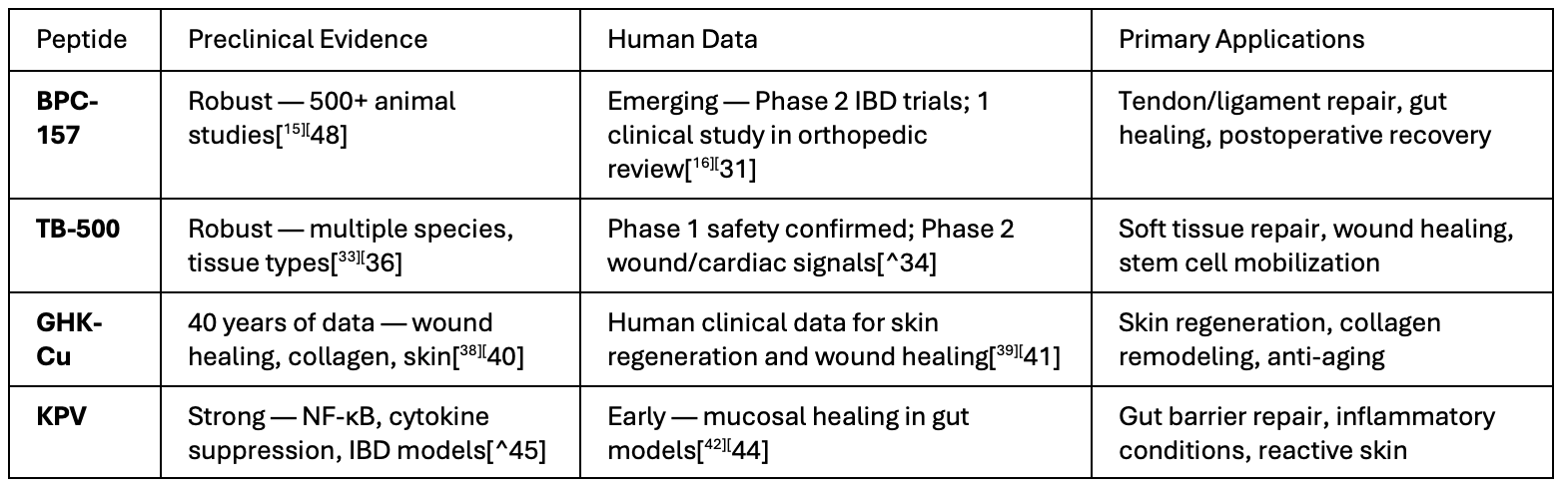
Evidence at a Glance: Repair & Recovery Peptides
The Honest Conversation About Evidence
As physicians committed to the evidence-based, Medicine 3.0 approach, it is important to be transparent: repair and recovery peptides do not yet have the large-scale Phase 3 randomized controlled trials that established pharmaceuticals possess. Most human data comes from small trials, case series, and Phase 1–2 safety studies.
What the data does show:
· Hundreds of peer-reviewed animal studies — across multiple species, tissue types, and injury models — consistently demonstrate regenerative, anti-inflammatory, and cytoprotective effects.
· Human Phase 1 safety data confirms tolerability with no serious adverse events at therapeutic doses.
· Early Phase 2 human signals in ophthalmology, cardiology, and gastroenterology provide meaningful proof-of-concept for biological activity in people.
· A robust and growing body of clinical observation from physicians using high-quality sourced peptides supports their practical utility.
At Paradigm Health, we pair this scientific foundation with real-world results — using these agents as part of individualized, carefully monitored protocols. We do not extrapolate beyond the evidence. We inform patients about what is known and what remains under investigation. And we do it all with the assurance that our product is clean, verified, and made in the USA.
Coming Next in the Series
This is the first in an ongoing Paradigm Health Peptide Series. Upcoming editions will explore:
· Part 2: GH Secretagogues — Sermorelin, Ipamorelin, CJC-1295, and Tesamorelin
· Part 3: Metabolic Peptides — AOD-9604, MOTS-c, and 5-Amino-1MQ
· Part 4: Neurocognitive Peptides — Cerebrolysin and beyond
Peptide therapy represents one of the most exciting frontiers in precision longevity medicine — not because it bypasses the body’s biology, but because it speaks its language. Stay tuned.
The information provided in this newsletter is for educational purposes. Peptide therapies are provided under the supervision of our clinical team. All patients are individually evaluated before initiating any peptide protocol.
— The Team at Paradigm Health