
The Reverse J of Aging: Why Setbacks Change Health Fast and How to Build Reserve

Aging is not usually a smooth decline. Many people follow a reverse J after surgery, illness, or injury and never fully regain function. Learn what reserve is, what to measure, and how to build a plan that helps you recover to a higher baseline.
Most people imagine aging as a straight line.
You feel a little slower each year. You lift a little less. Your energy fades one notch at a time.
That picture is intuitive, but it is not how aging usually works.
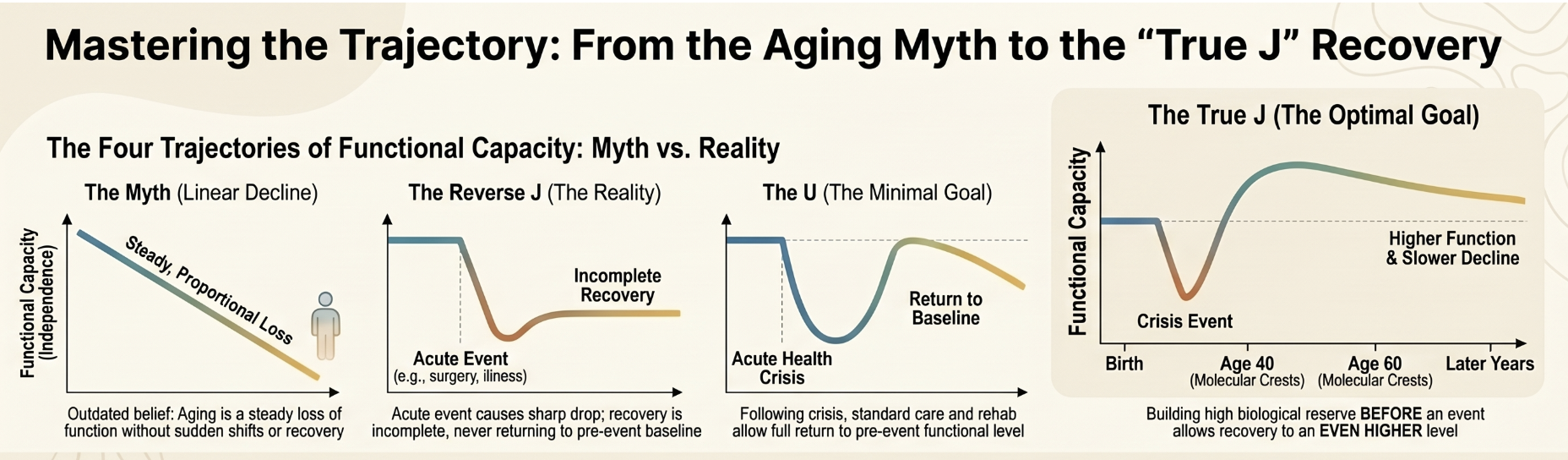
For many people, aging looks like a reverse J.
You function fine, then something happens.
A fall. A bad infection. A surgery. A hospitalization. A major injury.
Your function drops fast. The recovery is slow. And for many, it never returns to the old baseline.
That is the Reverse J of Aging.
Why the reverse J matters
The reverse J changes how we should think about prevention.
The main question is not “How old are you?”
The real question is “How much reserve do you have before the next hit arrives?”
If two people take the same hit, they can have very different outcomes.
A strong 62 year old and a fragile 62 year old have the same age. They do not have the same reserve.
Aging is often nonlinear
In multi-omics research, many biological features do not change in a smooth line. They change in waves. Two common transition windows show up around the mid 40s and again around age 60.
This matters because it means midlife is not a plateau. It is often the start of faster separation between people who build reserve and people who slowly lose it.
What is functional reserve
Reserve is your capacity buffer.
It is the extra strength, fitness, balance, and metabolic flexibility you can draw on when life gets expensive.
Think of reserve like a savings account.
If you have savings, a big expense hurts less.
If you have no savings, the same expense can change your life.
Reserve includes:
-
Strength and muscle mass
-
Cardiorespiratory fitness
-
Balance and coordination
-
Bone health
-
Metabolic health, including blood sugar and insulin resistance
-
Sleep quality
-
Nutrition, especially protein adequacy
The clearest example: hip fracture
Hip fracture is not just a broken bone.
It is often a full system stress test.
It exposes frailty, low muscle mass, poor balance, and low reserve.
In many studies, a large portion of patients do not return to their prior level of mobility and physical function after hip fracture.
That is the reverse J in real life.
The goal is not just a U, it is a true J
After a surgery or illness, most people aim for a U shaped recovery.
Survive the event. Rehab. Get back to baseline.
That is better than persistent decline, but it should not be the ceiling.
The better goal is a true J.
That means you end up stronger than you were before the event.
A true J happens when the recovery window is used to identify and fix hidden threats to health and independence.
Examples include:
-
Sarcopenia and weakness
-
Malnutrition and low protein intake
-
Sleep apnea and poor sleep
-
Insulin resistance
-
Low cardio fitness
-
Polypharmacy and risky medications
-
Balance deficits
-
Osteoporosis and low bone density
-
Untreated depression
-
Alcohol excess
-
Social isolation
A simple reserve scorecard
If you want to manage aging like an operator, track the inputs that drive reserve.
Here is a simple scorecard you can discuss with your clinician.
Strength and muscle
-
Can you sit to stand 5 times without using your hands?
-
Can you carry groceries without pain or instability?
-
Do you strength train at least 2 days per week?
Fitness
-
Can you walk briskly for 30 minutes?
-
Do you do Zone 2 style cardio 2 to 4 days per week?
Balance
-
Can you stand on one leg for 10 to 30 seconds each side?
-
Do you practice balance work weekly?
Bone
- If you are at risk, have you had a DEXA scan or bone health screening?
Metabolic health
-
Do you know your A1c, fasting insulin, and triglycerides?
-
Is your waistline trending up or down?
Recovery
-
Are you sleeping 7 to 8 hours most nights?
-
Are you getting enough daily protein?
How to build reserve
Reserve is built through consistent, boring excellence.
Here is a simple structure that works for most adults.
- Strength training
-
2 to 4 days per week
-
Focus on legs, hips, back, and core
-
Progress gradually
- Aerobic fitness
-
2 to 4 days per week
-
Start with walking, cycling, rowing, or incline treadmill
-
Build time before intensity
- Balance and mobility
-
2 to 3 short sessions per week
-
Include single leg work, step overs, and controlled direction changes
- Protein and nutrition
-
Prioritize protein at each meal
-
Build meals around whole foods
-
Keep blood sugar stable with balanced plates
- Sleep
-
Treat sleep as training
-
Fix the basics: light, caffeine timing, alcohol timing, and consistency
Prehab before surgery and rehab after
If a surgery is planned, your reserve can be improved before the operation.
That is called prehabilitation.
It often includes:
-
Strength work
-
Aerobic conditioning
-
Protein and nutrition support
-
Sleep optimization
-
Medication review
After illness or surgery, rehab matters, but it is not enough.
A true J requires a full plan that also addresses:
-
Muscle and strength rebuilding
-
Cardio fitness rebuilding
-
Balance and fall risk
-
Bone health if relevant
-
Metabolic risk and inflammation
-
Sleep and nutrition
How Paradigm approaches reserve and recovery
Paradigm’s Health Asset Management approach treats reserve like a measurable asset.
We assess and track:
-
Muscle and strength
-
Fitness
-
Balance and stability
-
Bone and fall risk
-
Metabolic and cardiovascular risk
-
Sleep and recovery
Then we build a personalized plan that fits your goals and your real life.
Medical note: This article is educational and not medical advice.